
Quantum X Labs is building a quantum algorithm for particle transport, the Monte Carlo workload behind radiation shielding, reactor design, and medical imaging. Our first prototype follows gamma-ray photons through a 2-D SPECT collimator. It is designed to become the oracle for quantum amplitude estimation, which needs on the order of 1/ε queries to reach statistical error ε, compared with 1/ε² samples for classical Monte Carlo.
The simulation bottleneck
Monte Carlo transport follows particles one history at a time, and its statistical error falls only as one over the square root of the number of histories. Halving the error costs four times the compute, so high-precision runs can take days [1].
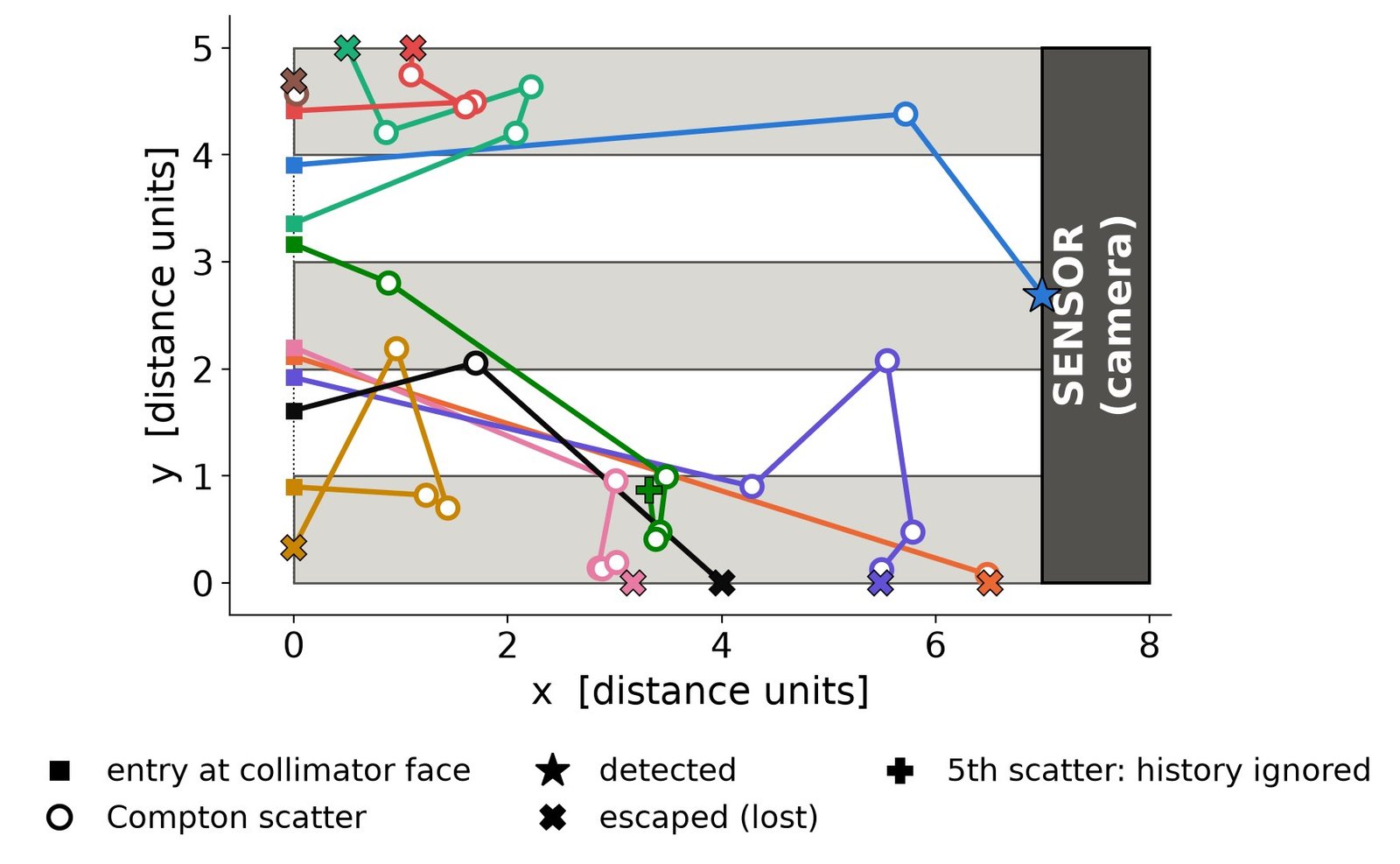
Single-Photon Emission Computed Tomography (SPECT) is a clear example. It reconstructs 3-D images from gamma rays emitted by a radioactive tracer in the body, and engineers simulate photon transport to balance resolution, sensitivity and dose. Before reaching the camera, photons pass a collimator: highly absorbing material with narrow holes that admits only photons traveling in selected directions. Modeling scattering, absorption and penetration in this structure is itself computationally demanding [2].
Three compact building blocks
Our aim is to reproduce the statistical logic of Monte Carlo transport in one reversible quantum circuit, without spending a quantum operation on every spatial step. The circuit has three parts.
Free flight. In a uniform material, the distance to the next interaction follows an exponential law; on a grid, its discrete counterpart is the geometric distribution. Drawing on the idea of holding times in stochastic processes [3], our hierarchical sampler locates the interaction by asking, level by level, whether it lies in the lower or upper half of the remaining range. Each answer is one qubit set by an independent single-qubit rotation, with no controlled gates, so an 8 × 8 grid needs 6 qubits instead of the 64 a cell-by-cell register would use. Sampling in optical depth extends the method to several materials.
Geometry. For a regular structure such as a collimator, simple arithmetic rules identify the material at a position and whether a path crosses a boundary. We implement these checks as a reversible geometry oracle, so the circuit queries the structure coherently instead of storing every cell. Pseudorandom geometry oracles [4] offer a route to defects and material variations.
Scattering direction. After a Compton scatter, the new direction follows the Klein–Nishina distribution. We approximate its amplitude with a degree-4 polynomial and load it as a Matrix Product State circuit of bond dimension 5 [5], keeping preparation cheap for repeated scatters.
What the prototype shows
We ran the full transport circuit for a 2-D parallel-hole collimator with two holes on the Qiskit Aer MPS simulator, with 100,000 shots and up to four scatters per photon. The simulator detects 20.2% of photons, 75.4% scatter without being detected (including 15.5% that pass the four-scatter limit), and 4.4% pass through the sides without scattering.
The sampled counts match the circuit’s exact outcome probabilities within shot noise. Against a continuous-space classical Monte Carlo reference, differences remain visible, most clearly in histories with more than four scatters; narrowing that gap is part of the next stage.
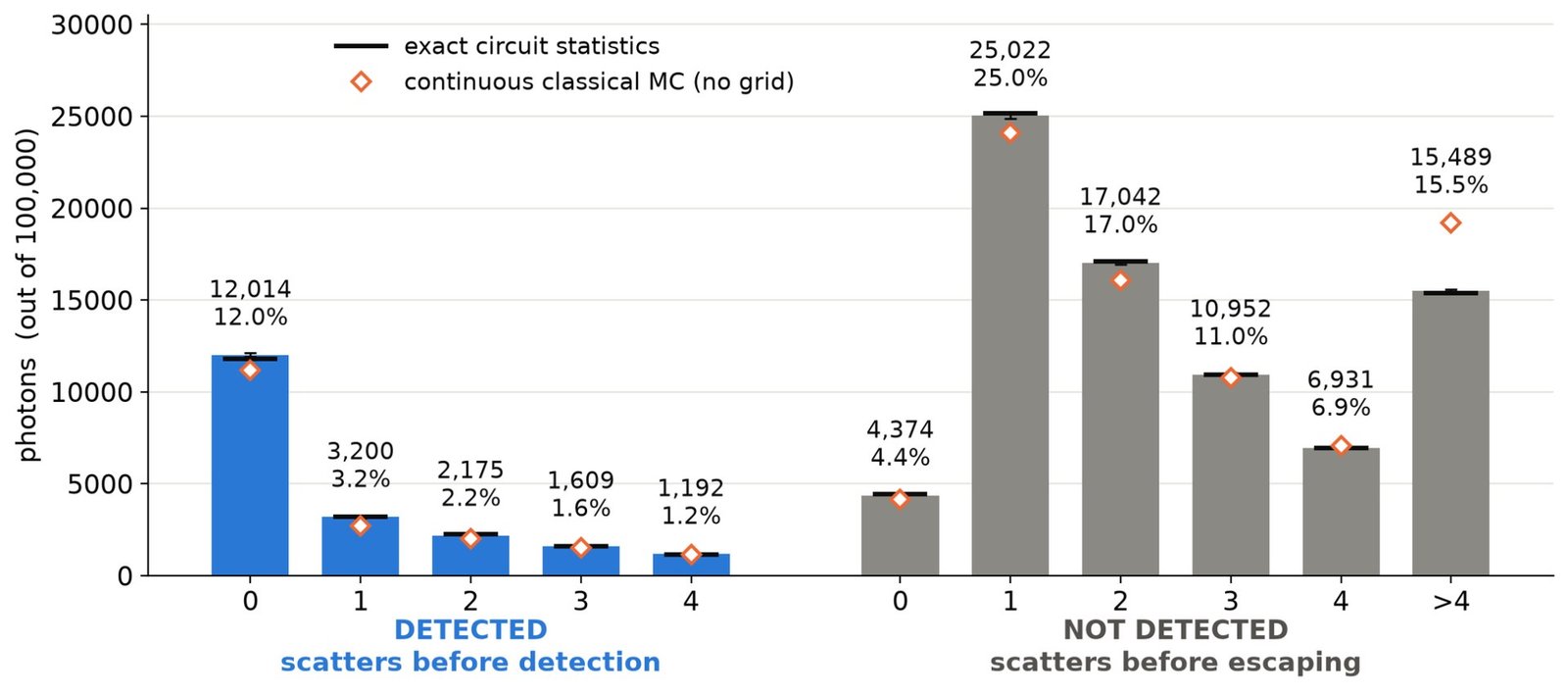
Tested on their own, both samplers reproduce their targets. The MPS circuit matches the Klein–Nishina distribution at 140.5 keV, the photon energy of technetium-99m, across 64 angular bins. Five single-qubit rotations reproduce the geometric free-flight distribution across 32 optical-depth bins.
From photon histories to amplitude estimation
Together, these parts are meant to form a reversible transport oracle that encodes possible photon histories and marks an outcome of interest, such as detection in a chosen energy window. Quantum amplitude estimation then estimates that probability through repeated coherent calls to the oracle and its inverse. In principle, the number of calls grows quadratically more slowly with the target precision than independent Monte Carlo sampling does.
Turning that into a real runtime gain depends on keeping the whole oracle cheap, which is why each building block is designed to be compact. Our next steps are to extend the model to 3-D and more complex geometries and to estimate the resources amplitude estimation will need. The longer-term goal is to combine these methods with classical simulation tools for faster, high-precision simulation in SPECT and wider nuclear engineering.
Technical sources
- García-Pareja S, Lallena AM, Salvat F. Variance-reduction methods for Monte Carlo simulation of radiation transport. Front. Phys. 9:718873 (2021). doi:10.3389/fphy.2021.718873
- Descourt P et al. Implementation of angular response function modeling in SPECT simulations with GATE. Phys. Med. Biol. 55 N253 (2010).
- Zhuang X-N, Chen Z-Y, Xue C, Wu Y-C, Guo G-P. Quantum encoding and analysis on continuous time stochastic processes with financial applications. arXiv:2208.02364
- Barthe A. How to make quantum cheese: efficient geometry oracles for exponentially many pseudorandom microstructures. arXiv:2606.00222
- Holmes A, Matsuura AY. Efficient quantum circuits for accurate state preparation of smooth, differentiable functions. arXiv:2005.04351
