Solutions
What are we working on:
We are working on clock that uses an optical local oscillator (e.g., a directly modulated diode laser or VCSEL) to generate the CPT fields, and an electronic local oscillator (LO) that is frequency-synthesized to the Rb ground-state hyperfine transition (e.g., 6.834 GHz for ^87Rb). An electronic servo loop references the LO to the atomic resonance by locking to the Ramsey–CPT signal, yielding improved short- and medium-term stability compared to conventional vapor-cell CPT clocks and enabling a compact, low-power frequency reference suitable for portable and embedded applications.
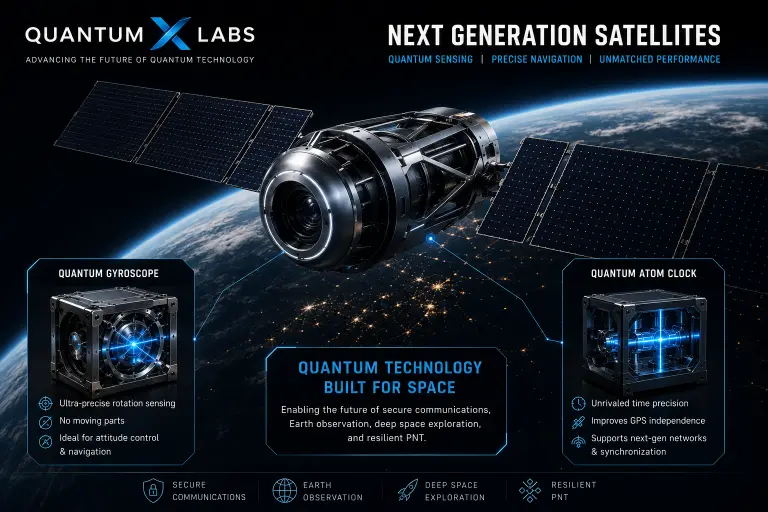
Next-Gen Satellite Platforms
A greater autonomy, precision, and resilience requires quantum-based timing and navigation
Our neutral-atom platform, with the long-term goal of enabling compact, high-precision systems suited for satellite integration.
Quantum X Labs is developing quantum atom clock and quantum navigation sensing technologies, built on our neutral-atom platform, with the long-term goal of enabling compact, high-precision systems suited for satellite integration.Why this direction matters:
- Timing resilience — quantum atom clocks could offer drift-free timing independent of GPS corrections, valuable for large constellations like Starlink
- Autonomous deep-space navigation — GPS-independent quantum sensing could support missions where traditional positioning isn’t available (Moon, Mars)
- Signal security — quantum-based timing could harden synchronization against jamming and spoofing for commercial and defense payload
- Earth observation — quantum sensing could enable subsurface and gravimetric mapping at precision levels classical sensors can’t reach
We're at the early stages of applying our quantum hardware expertise to this domain, and we believe the satellite industry's move toward quantum-enabled systems is a matter of when, not if...
From
