
Solutions
About nuclear engineering and heavy simulations
Particle transport is a critical computational bottleneck across nuclear reactors, medical imaging, radiation therapy, and many other complex systems.
Today, these problems rely heavily on Monte Carlo simulations, requiring enormous numbers of particle trajectories to reach high precision.
Despite the advantages nuclear applications may have for our day-to-day lives, research and development in this field is often delayed by heavy simulations.
Our solution
In Nuclear Quantum, we explore how quantum algorithms can drastically reduce the number of samples needed to reach the same precision, opening the door to faster simulations, better design decisions, and more accurate modeling of some of the world’s most complex physical systems.
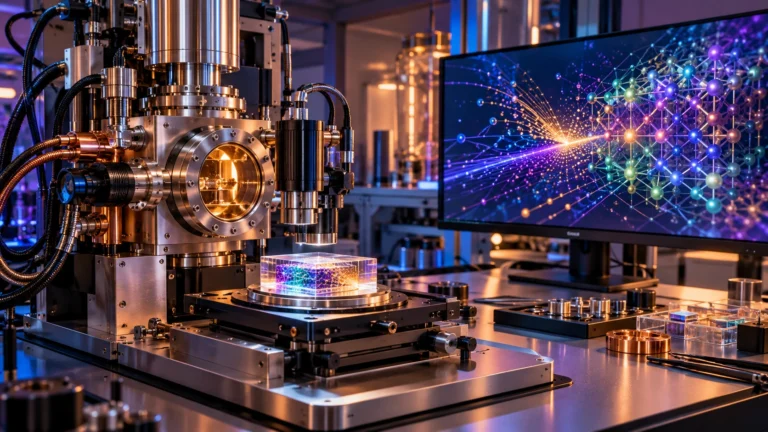
Particle transport
Following particles through matter
Each path is a particle crossing layers of material: it travels, scatters, and is either absorbed or passes through. Transport codes follow enormous numbers of such paths.
Simulation highlights
Particle transport is mapped onto a compact quantum representation of stochastic propagation and interaction histories.
Hierarchical state preparation encodes free-flight and collision statistics without resolving every transport step explicitly.
Quantum-controlled interaction and boundary logic captures scattering, absorption, and propagation across heterogeneous media.
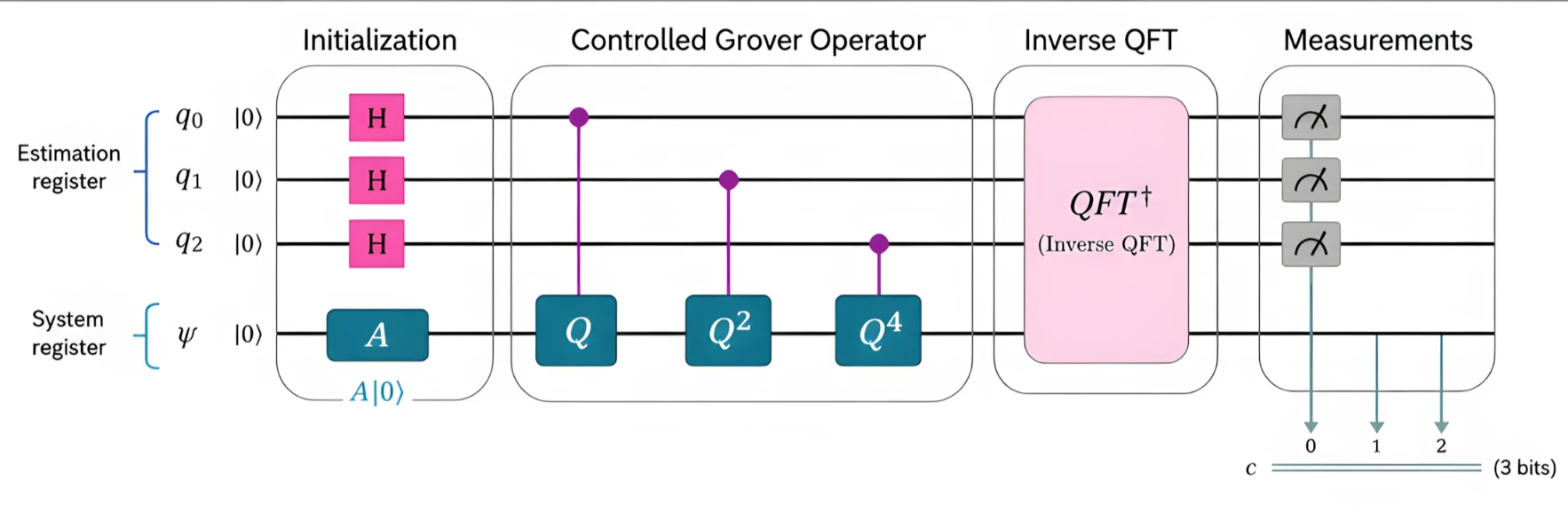
The resulting transport circuit forms a reusable simulation primitive (oracle) designed for integration with quantum amplitude-estimation methods.
Integrating quantum simulation into the classical framework
Faster design, deeper insight, and better optimization require quantum-accelerated nuclear simulation.
Where we are
Tested, in development, and available today
What has been tested and under which conditions, what is still being developed, and how to work with us now.
Tested
- SimulationFull transport circuit for a 2-D parallel-hole collimator with two holes, run on the Qiskit Aer MPS simulator with 100,000 shots and up to four scatters per photon (the prototype).
In development
- Narrowing the remaining gap to the classical Monte Carlo reference in histories with more than four scatters.
- Using the transport circuit as the oracle for quantum amplitude estimation.
With us today
- Feasibility study on your particle-transport problem.
- Technical discussion about integration with your simulation workflow.
Every pilot has a defined deliverable, such as a written feasibility assessment or a benchmark report on your data. We do not promise a result in advance.
