NMR gyroscope
Measures rotation through the behaviour of atomic nuclei in a magnetic field: xenon nuclei precess at a well-defined Larmor frequency and are read out optically. No moving mechanical parts.
In development · patent pending

Solutions · Quantum Sensing
Rotation sensing and precision timing built on atomic physics, for systems that cannot rely on an external reference.
The problem
Anything that moves needs to know how it is turning, and every system that communicates, navigates or synchronises depends on a stable sense of time.
When GNSS is unavailable, contested or jammed, the platform falls back on its own sensors and its own clock, and their limits become the limits of the whole system.
Without a stable reference, error keeps growing. A reference tied to atomic physics keeps it inside a narrow band.
Our approach
Measures rotation through the behaviour of atomic nuclei in a magnetic field: xenon nuclei precess at a well-defined Larmor frequency and are read out optically. No moving mechanical parts.
In development · patent pending
A hemispherical resonator whose vibration pattern shifts when the device rotates, read out with low-noise laser detection.
In development
A compact vapour-cell clock that locks an electronic oscillator to the rubidium ground-state transition, targeting improved short- and medium-term stability.
In development · patent pending
Explore
Rotation sensing · Navigation
High-precision navigation when GPS is unavailable or jammed, with two architectures: the NMR gyroscope and the optically read HRG.
In development
Precision timing
A rubidium Ramsey-CPT clock for portable and embedded applications, where timing has to hold without GNSS.
In development · patent pending
In the lab
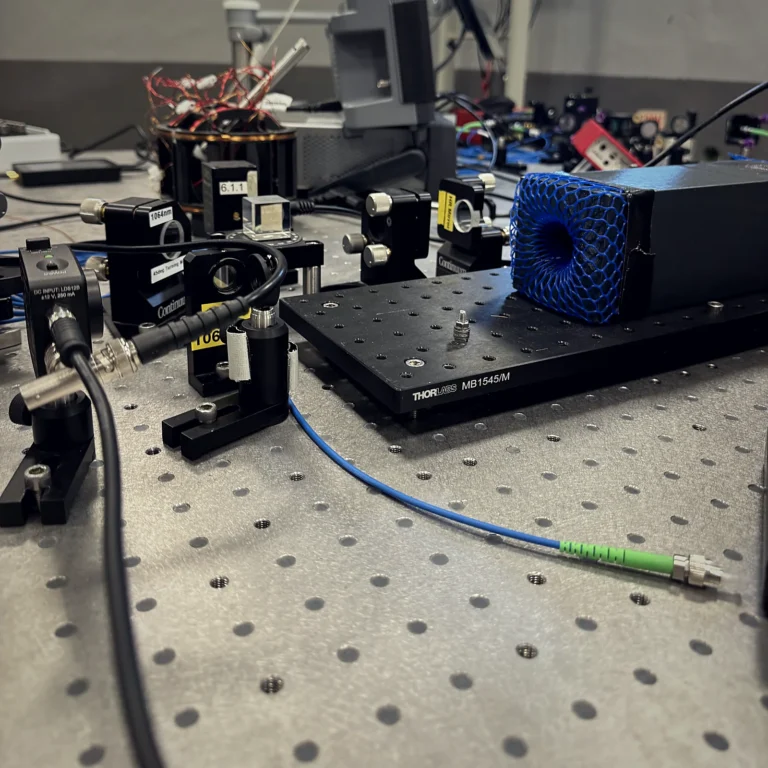
Lasers, optics and electronics on the bench where our atomic-clock work takes place.
Tell us the measurement that is holding you back. We will say honestly whether our work applies.
Talk to the sensing team