Solutions
Building and owning quantum gyroscope
Quantum Gyro measures rotation by tracking the Larmor precession of noble-gas nuclear spins in an alkali/noble-gas vapor cell. Optical readout enables high sensitivity with a pathway to miniaturization and lower power.
Technology snapshot
- Optical pumping polarizes alkali atoms; spin-exchange transfers angular momentum to noble-gas nuclei.
- A resonant AC magnetic field drives coherent nuclear spin precession.
- Signal is read out optically via alkali-atom magnetometry (Fermi-contact enhanced).
Why it matters
- Precision rotation sensing for inertial navigation and stabilization.
- Designed for GNSS-denied environments where drift and bias stability are critical.
- End-2026 targets: improved bias, scale factor stability, reduced size and power.
Next-Gen Satellite Platforms
A greater autonomy, precision, and resilience requires quantum-based timing and navigation
Our neutral-atom platform, with the long-term goal of enabling compact, high-precision systems suited for satellite integration.
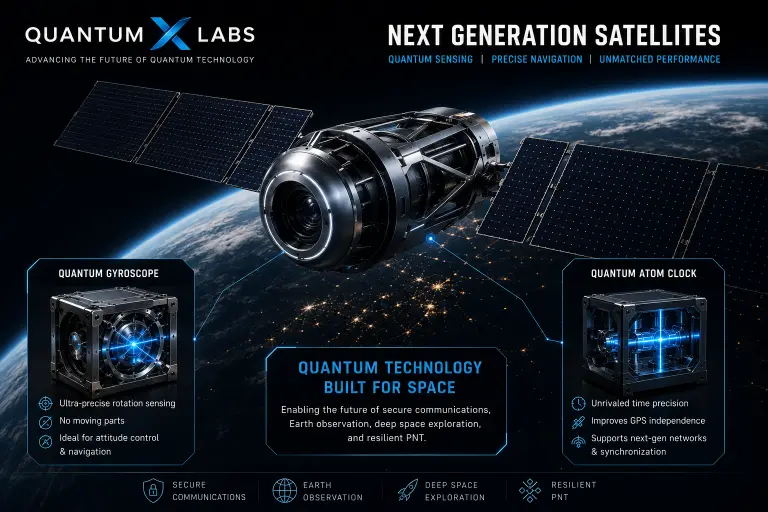
Quantum X Labs is developing quantum atom clock and quantum navigation sensing technologies, built on our neutral-atom platform, with the long-term goal of enabling compact, high-precision systems suited for satellite integration.Why this direction matters:
- Timing resilience — quantum atom clocks could offer drift-free timing independent of GPS corrections, valuable for large constellations like Starlink
- Autonomous deep-space navigation — GPS-independent quantum sensing could support missions where traditional positioning isn’t available (Moon, Mars)
- Signal security — quantum-based timing could harden synchronization against jamming and spoofing for commercial and defense payload
- Earth observation — quantum sensing could enable subsurface and gravimetric mapping at precision levels classical sensors can’t reach
We're at the early stages of applying our quantum hardware expertise to this domain, and we believe the satellite industry's move toward quantum-enabled systems is a matter of when, not if...
From
