
The Power of Neutral Atom Quantum Computer
Our platform leverages advanced laser cooling technology combined with dynamically reconfigurable optical tweezer arrays. This architecture enables rapid, high-fidelity loading of large- scale qubit registers, extended coherence times, and native support for high-performance Rydberg- mediated two-qubit gates.
Our Qubit Strategy
We aim to reach thousands of qubits, on a logical pathway that includes a plan of integrating the company’s patent-pending deep transformer decoder (US12294387B2). This AI-based error correction system is tightly coupled with the neutral-atom control stack. Using syndrome-guided decoding, it establishes a low-latency feedback loop that processes the high-fidelity outputs of the Rydberg gates in real time. This unique hardware-AI co-design dramatically reduces computational overhead and establishes a practical pathway toward real-time, fault-tolerant logical qubit operations.
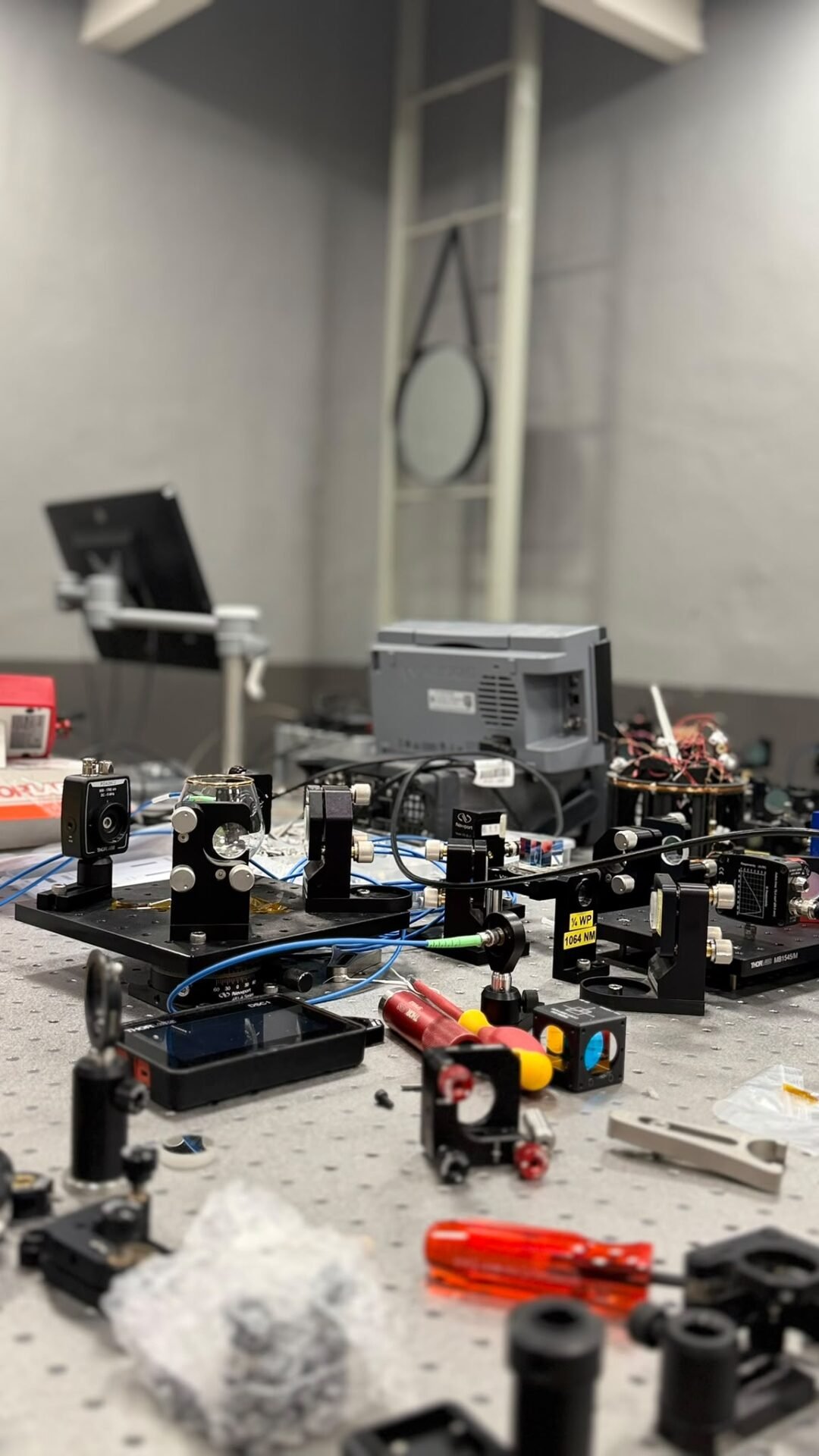
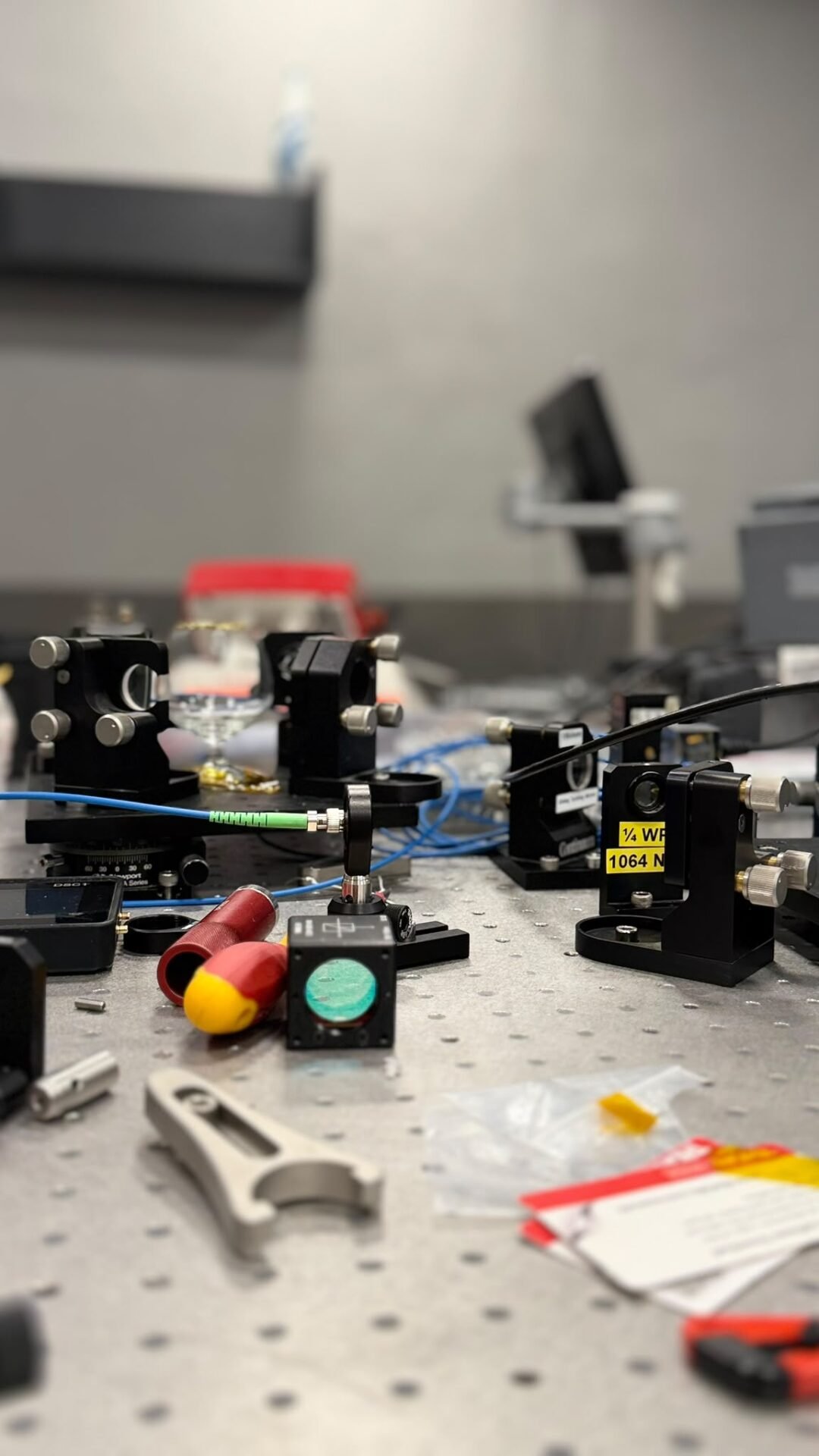
Our Lab


How it works
From neutral atoms to computation
How a quantum computer based on neutral atoms works, in four steps.
-
Prepare & cool
Atoms are slowed and cooled with laser light until they are almost still.
-
Trap & arrange
Optical tweezers, tightly focused laser beams, hold single atoms. The array is rearranged into the layout a program needs.
-
Operate
Laser pulses drive single-qubit gates. Exciting neighbouring atoms to Rydberg states creates native two-qubit gates.
-
Read out
The array is imaged: each site either fluoresces or stays dark, which reads out its qubit state.
01Prepare & cool
Atoms are slowed and cooled with laser light until they are almost still.
02Trap & arrange
Optical tweezers, tightly focused laser beams, hold single atoms. The array is rearranged into the layout a program needs.
03Operate
Laser pulses drive single-qubit gates. Exciting neighbouring atoms to Rydberg states creates native two-qubit gates.
04Read out
The array is imaged: each site either fluoresces or stays dark, which reads out its qubit state.
Inside the system
Around the atoms
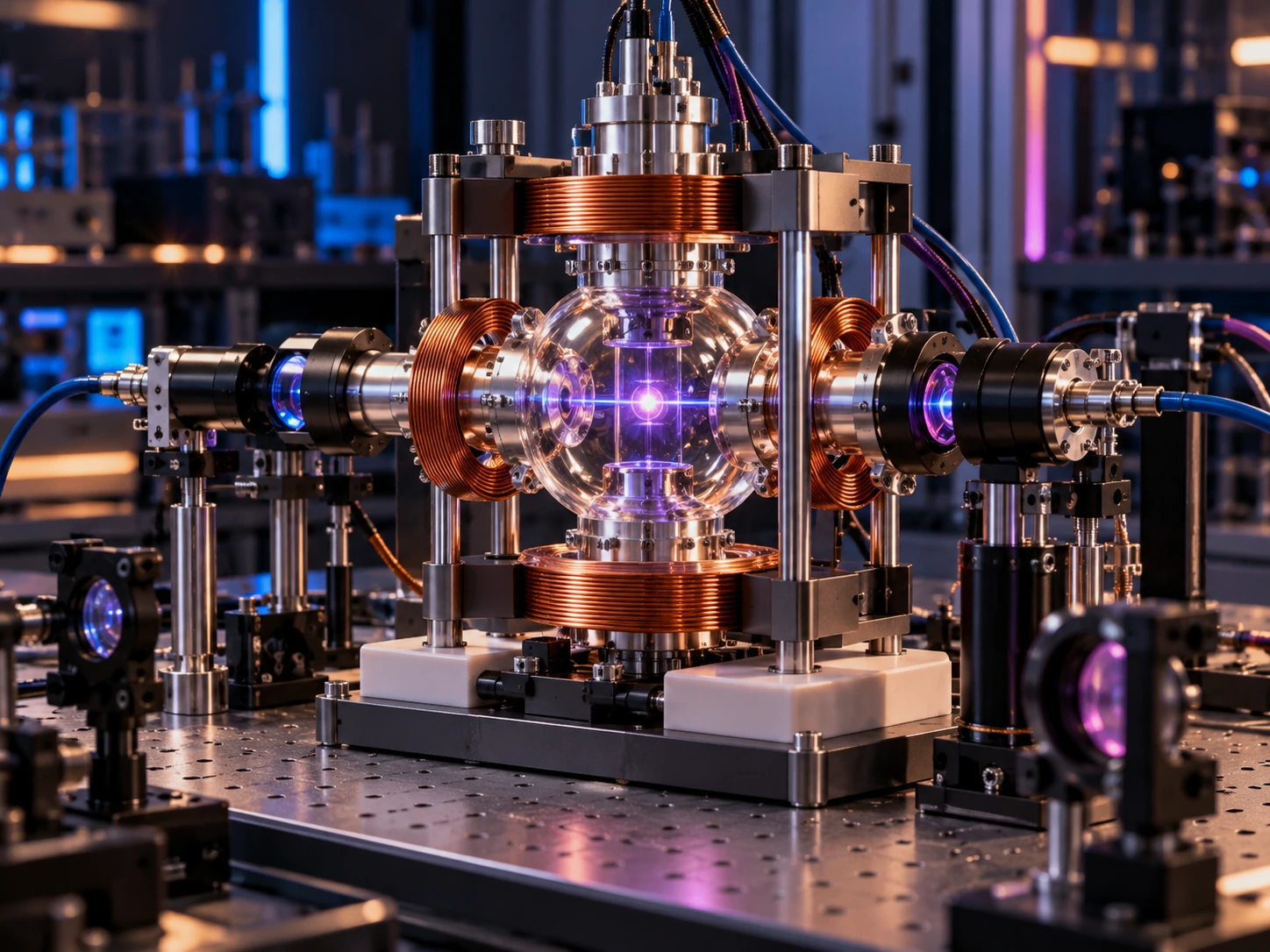
The parts that surround a neutral-atom register. Select a number to see what each one does.
- 1
Vacuum cell
A glass cell under ultra-high vacuum. The atoms are trapped and controlled inside it.
- 2
Magnetic-field coils
Copper coils create the magnetic fields that work with laser light to capture and cool atoms.
- 3
Optical access
Laser beams for cooling, trapping and control reach the atoms through windows around the cell.
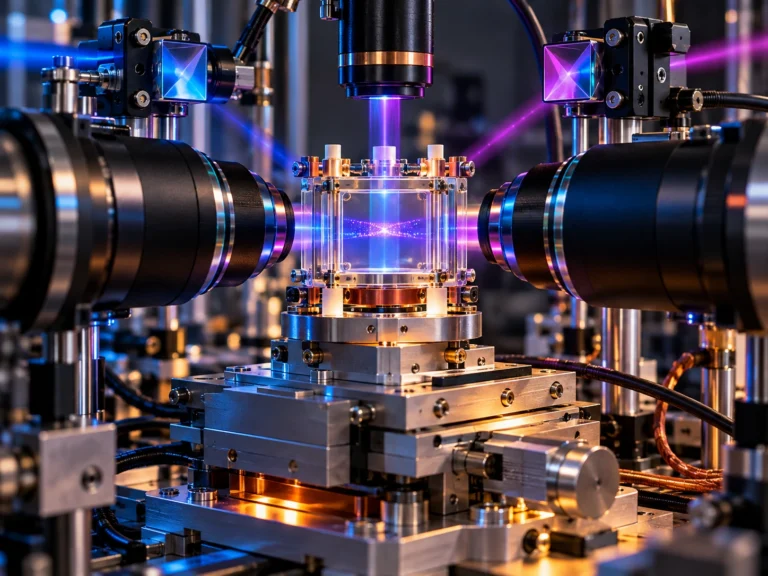
Trapping optics
Lenses focus laser light into the array of optical tweezers that hold the atoms.
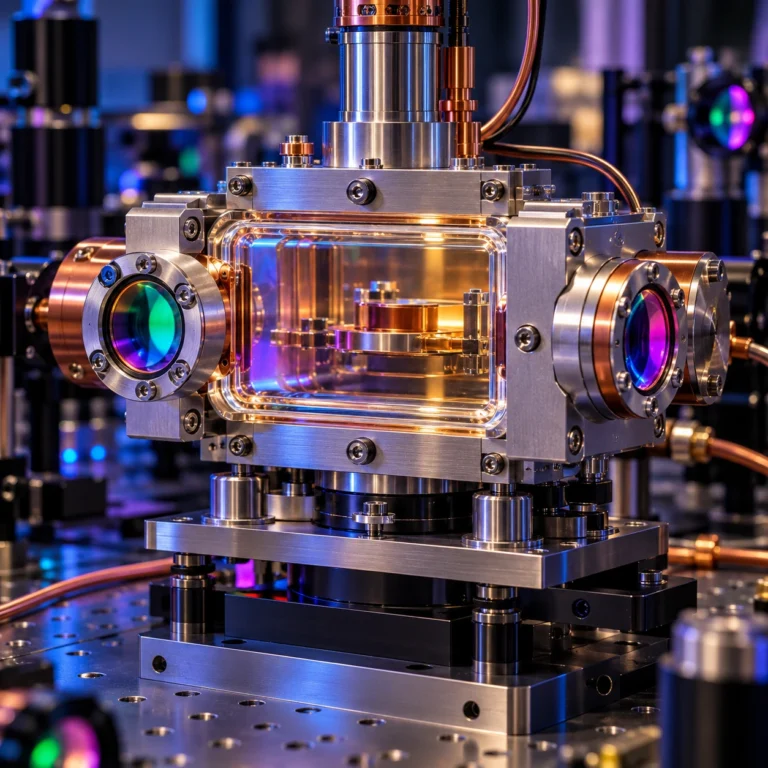
Vacuum cell, close up
Optical windows on each side let the laser beams in and the light from the atoms out.
Inside our lab
The neutral-atom apparatus
The vacuum system at the heart of our neutral-atom work, photographed in our lab.
Where we are
Tested, in development, and available today
What has been tested and under which conditions, what is still being developed, and how to work with us now.
Tested
- Hardware50+ physical qubits on our platform based on neutral atoms, with native Rydberg two-qubit gates. Platform launched May 2026 (roadmap).
In development
- Logical qubits: the roadmap targets <20 logical qubits in 2027 and ~100 in 2029.
- Integrating the AI-assisted error-correction decoder with the control stack for a low-latency feedback loop.
With us today
- Technical discussion about neutral-atom hardware and integration.
- Component inquiry: atom sources, 2D MOT and Zeeman slowers (Core Products).
Every pilot has a defined deliverable, such as a written feasibility assessment or a benchmark report on your data. We do not promise a result in advance.