Solutions
About nuclear engineering and heavy simulations
Particle transport is a critical computational bottleneck across nuclear reactors, medical imaging, radiation therapy, and many other complex systems.
Today, these problems rely heavily on Monte Carlo simulations, requiring enormous numbers of particle trajectories to reach high precision.
Despite the advantages nuclear applications may have for our day-to-day lives, research and development in this field is often delayed by heavy simulations.
Our solution
In Nuclear Quantum, we explore how quantum algorithms can drastically reduce the number of samples needed to reach the same precision, opening the door to faster simulations, better design decisions, and more accurate modeling of some of the world’s most complex physical systems.
Simulation highlights
Particle transport is mapped onto a compact quantum representation of stochastic propagation and interaction histories.
Hierarchical state preparation encodes free-flight and collision statistics without resolving every transport step explicitly.
Quantum-controlled interaction and boundary logic captures scattering, absorption, and propagation across heterogeneous media.
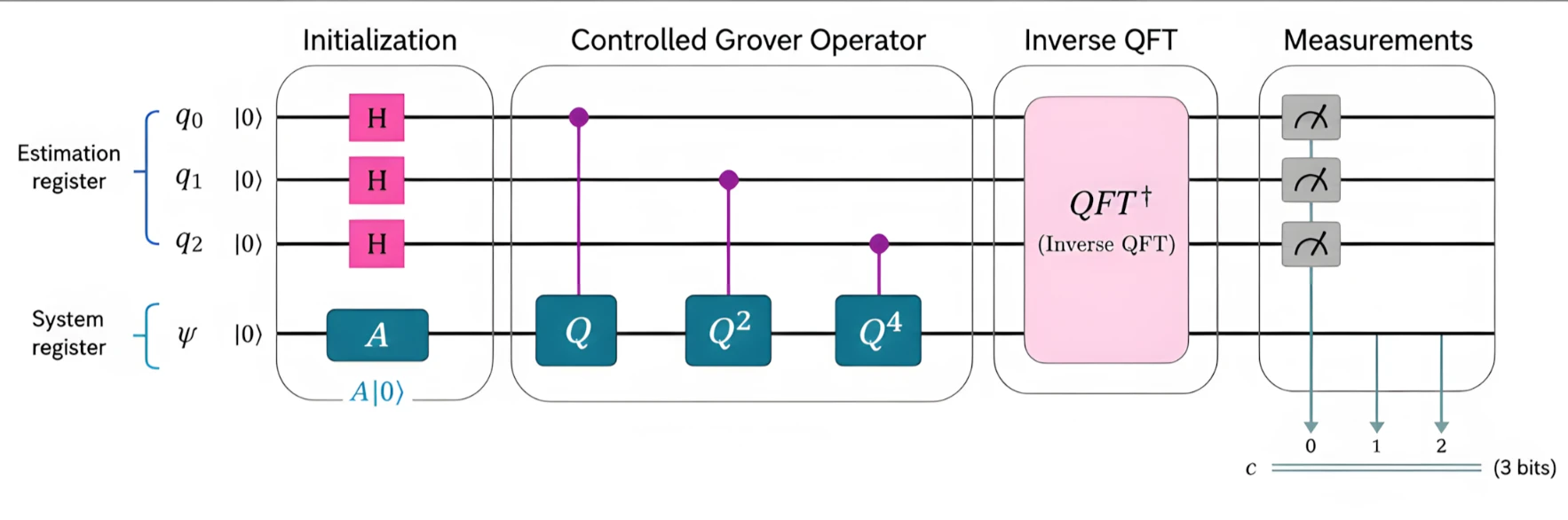
The resulting transport circuit forms a reusable simulation primitive (oracle) designed for integration with quantum amplitude-estimation methods.
Integrating quantum simulation into the classical framework
Faster design, deeper insight, and better optimization require quantum-accelerated nuclear simulation.